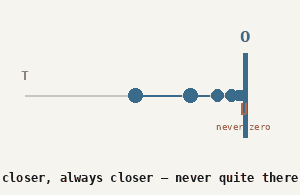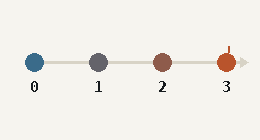
Zeroth gives you a reference. First says nothing spent against it is wasted. Second says, left alone, everything drifts one direction. Third says even endless effort only approaches the far end of that drift — it never arrives.
Four separate posts, four separate diagrams, four separate weeks. Taken one at a time, each law reads as its own small metaphor — a thermometer, a balance scale, a melting ice cube, a wall you never quite touch. It would be easy to leave it there. But the four laws weren’t picked at random, and neither were the essays. They’re one argument, told in four movements.
Start with the zeroth law: three things in contact settle to the same state, which is the only reason “temperature” — or “order,” or “steady” — is a meaningful word at all. Without a reference point, change can’t even be measured, let alone resisted. The first law supplies the mechanism: energy spent holding a reference point in place doesn’t vanish, it converts — ΔU = Q − W, the ledger always balances. The second law explains why that spending is necessary at all: left alone, everything drifts toward disorder, and order is rented, never owned outright. And the third law puts a floor under the whole system — even unlimited effort against the drift only approaches the state of perfect order, absolute zero, and never actually lands on it.
Reference, mechanism, direction, limit. That’s not four unrelated facts about physics. That’s the complete shape of what it takes to hold anything together on purpose.
I’ll admit I sat down wanting these four pieces to click into one tidy “aha” — a single sentence that would make the whole series feel finished. What I got instead was closer to what the third law already told us two weeks ago: a shape you keep approaching, not a punchline you arrive at. This post isn’t the final word on what the four laws mean together. It’s just this month’s closest approach.
Calibrate against something stable rather than a moving target — that’s the zeroth law’s gift, a common measure of reality. From that steady place, spend your effort on what’s actually yours to control, and trust that none of it is wasted, only transformed. Expect the drift — decay isn’t a personal failure, it’s the default setting of everything, and you only get to choose what you hold together. And don’t wait to feel finished before you count the progress: you’re the prokopton, the one still closing the distance, not the sage who already arrived. Four ideas, one continuous practice.
Water finds its own level without anyone pushing it there — wu wei, the zeroth law’s stillness. Cook Ding’s blade stays sharp for nineteen years because he follows the grain instead of forcing his way through it — nothing lost, only moved along the natural seam, the first law in a kitchen. The river only flows one way, and wisdom is moving with that current instead of exhausting yourself fighting it — the second law’s lesson. And the Dao that can be spoken is not the eternal Dao: description can circle the thing, approach it, gesture at it, but a finite sentence never equals an infinite one — even naming the Way is an act of moving with the current, not capturing it. Four images, one river.
- You need a stable reference before “change” or “order” mean anything at all — that’s what equilibrium gives you.
- Nothing spent holding that reference in place disappears. It converts. The honest question is always what it became, not whether it was wasted.
- Without that spending, everything drifts one direction, toward disorder — that’s the baseline of the universe, not a verdict on your character.
- Even unlimited effort against the drift only approaches the floor. It’s a horizon, not a finish line — and that’s not a design flaw, it’s the whole shape of the thing.
This closes the loop the Third Law post opened two weeks ago — the four-law series that began with the Zeroth and Second Laws together, went deeper on entropy in why order is so strange, filled in the First Law, and closed with the Third. Thermodynamics turned out to be a good language for this project because it describes change in almost embarrassingly literal terms — a reference, a conservation, a direction, a limit. That’s probably not unique to thermodynamics. The open question this project wants to sit with next: what other frameworks, physical or otherwise, are quietly describing the same shape in different vocabulary — and is that a coincidence, or just what change looks like from any angle studied closely enough? New here? The project’s starting point explains why this site keeps circling back to the same three things.
A question for you: of the four — reference, conservation, direction, limit — which one do you find hardest to actually live by, not just agree with?
此文亦有中文版:《斯多葛感悟:四条定律,一个形状》。