The acceleration of a body is proportional to the net force on it and inversely proportional to its mass: a = F / m.
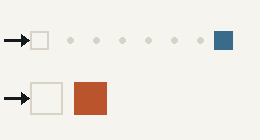
Give a pebble and a boulder the same shove. The pebble leaps away; the boulder shifts a hair. Nothing mysterious is going on: what differs isn’t the push, it’s how much there is to move. Newton’s word for that is mass — a measure of how strongly a thing resists having its motion changed. (His own wording in the Principia, 1687, spoke of the change in a body’s motion; the tidy a = F / m is the modern shorthand.)
The part worth sitting with is the denominator. Ask for the same change from something twice as heavy and you need twice the force — or you wait twice as long for the change to build. Heavy things aren’t broken versions of light ones; they trade quickness for steadiness. A loaded freight train is hard to start and just as hard to stop.
I used to judge how quickly I could change a habit, a job, a mood purely by how hard I was pushing — and when nothing moved, I decided the push was weak. I’m learning to ask a different question first: how much am I carrying? (Same caveat as last time: this is a metaphor, not a theory of psychology — but it has changed what I check first.)
In the Meditations (4.49), Marcus Aurelius says to be like the promontory against which the waves keep breaking: it stands firm, and the water around it grows calm. Read in a physicist’s key (my gloss, not his words): a large mass isn’t thrown around by small forces. Steadiness isn’t the absence of pressure — it’s having enough substance behind you that a given blow produces only a small change.
Chapter 26 of the Daodejing says 重為輕根,靜為躁君 — the heavy is the root of the light, and stillness is the master of restlessness. Weight here isn’t a burden to throw off but the foundation that lightness stands on. Chapter 64 supplies the other half: 合抱之木,生於毫末;九層之臺,起於累土 — the tree you can’t wrap your arms around grew from a tiny shoot, and the nine-storey tower began as a heap of earth. If heavy things move slowly under one push, the Dao’s answer isn’t a bigger shove but many small ones, patiently.
- When the same effort gets different results, check the mass before blaming the push. What you’re carrying decides how much a given effort changes you.
- Weight isn’t a flaw. It costs you quickness and buys you steadiness — so the useful question isn’t “how do I get lighter?” but “which of this is worth its weight?”
- A small force isn’t a zero force. Keep a gentle push going long enough and the change adds up — which is how a boulder eventually moves.
This is Part 2 of the series pairing Newton’s three laws of motion with a Stoic and Daoist reading. Part 1, on inertia, asked why things don’t stop by themselves; this one asks why the same push doesn’t move everything equally. The thermodynamics series before it wrapped up in The Four Laws, Taken Together. Next: the Third Law — why every push comes with a push back, and what that means for whoever is on the other end of yours. New here? The project’s starting point explains why this site keeps circling back to the same three things.
A question for you: what’s one thing you’ve been blaming your effort for — when the real issue might be how much you’re carrying?
此文亦有中文版:《从牛顿第二定律看生活之道》。

