Stoic Insights: Same Push, Different Weight

Notes — Laws of Motion, Part 2
Newton’s Second Law, as a Way of Living
Why the same push moves one thing a long way and another barely at all — and what that says about the weight we carry.
Newton’s Second Law
Force, Mass, and Acceleration
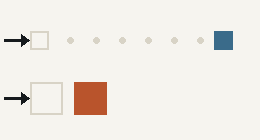
Two rows. Top: a small square given a push (black arrow) travels far across a dotted track to a blue square. Bottom: a large square given the same push moves only a short way to an orange square.

The acceleration of a body is proportional to the net force on it and inversely proportional to its mass: a = F / m.

Give a pebble and a boulder the same shove. The pebble leaps away; the boulder shifts a hair. Nothing mysterious is going on: what differs isn’t the push, it’s how much there is to move. Newton’s word for that is mass — a measure of how strongly a thing resists having its motion changed. (His own wording in the Principia, 1687, spoke of the change in a body’s motion; the tidy a = F / m is the modern shorthand.)

The part worth sitting with is the denominator. Ask for the same change from something twice as heavy and you need twice the force — or you wait twice as long for the change to build. Heavy things aren’t broken versions of light ones; they trade quickness for steadiness. A loaded freight train is hard to start and just as hard to stop.

I used to judge how quickly I could change a habit, a job, a mood purely by how hard I was pushing — and when nothing moved, I decided the push was weak. I’m learning to ask a different question first: how much am I carrying? (Same caveat as last time: this is a metaphor, not a theory of psychology — but it has changed what I check first.)

Stoic reading

In the Meditations (4.49), Marcus Aurelius says to be like the promontory against which the waves keep breaking: it stands firm, and the water around it grows calm. Read in a physicist’s key (my gloss, not his words): a large mass isn’t thrown around by small forces. Steadiness isn’t the absence of pressure — it’s having enough substance behind you that a given blow produces only a small change.

Daoist reading

Chapter 26 of the Daodejing says 重為輕根,靜為躁君 — the heavy is the root of the light, and stillness is the master of restlessness. Weight here isn’t a burden to throw off but the foundation that lightness stands on. Chapter 64 supplies the other half: 合抱之木,生於毫末;九層之臺,起於累土 — the tree you can’t wrap your arms around grew from a tiny shoot, and the nine-storey tower began as a heap of earth. If heavy things move slowly under one push, the Dao’s answer isn’t a bigger shove but many small ones, patiently.

Three takeaways
  1. When the same effort gets different results, check the mass before blaming the push. What you’re carrying decides how much a given effort changes you.
  2. Weight isn’t a flaw. It costs you quickness and buys you steadiness — so the useful question isn’t “how do I get lighter?” but “which of this is worth its weight?”
  3. A small force isn’t a zero force. Keep a gentle push going long enough and the change adds up — which is how a boulder eventually moves.
Continuing the thread

This is Part 2 of the series pairing Newton’s three laws of motion with a Stoic and Daoist reading. Part 1, on inertia, asked why things don’t stop by themselves; this one asks why the same push doesn’t move everything equally. The thermodynamics series before it wrapped up in The Four Laws, Taken Together. Next: the Third Law — why every push comes with a push back, and what that means for whoever is on the other end of yours. New here? The project’s starting point explains why this site keeps circling back to the same three things.

A question for you: what’s one thing you’ve been blaming your effort for — when the real issue might be how much you’re carrying?

此文亦有中文版:《从牛顿第二定律看生活之道》。
a = F / m — same push, different weight, different result

Stoic Insights: Things Don’t Stop on Their Own

Notes — Laws of Motion, Part 1
Newton’s First Law, as a Way of Living
One law of motion, and what it teaches about habits, momentum, and the forces we’ve stopped noticing.
Newton’s First Law
Inertia
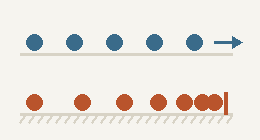
Two rows of dots. Top row: evenly spaced blue dots on a smooth line with an arrow, still moving. Bottom row: orange dots bunching closer together on a rough, hatched line and ending at a stop bar.

A body at rest stays at rest, and a body in motion keeps moving in a straight line at a steady speed, unless a net outside force acts on it.

Roll a ball across a table and it stops. For nearly two thousand years, that looked like the obvious lesson: things come to rest on their own, and motion needs something to keep pushing. Then Galileo and Newton noticed that the ball isn’t stopping by itself. Something is stopping it — friction, air — a force so constant that we stopped counting it as a force at all. Take it away (on ice, on an air-hockey table, in space) and the ball just keeps going.

That flips the first principle. Stillness isn’t the natural default, and neither is motion. The default is persistence: whatever state a thing is in, it stays in until something acts on it.

I notice I still treat my own stalled projects as if they stopped by themselves — as if the stillness were natural — instead of asking what is actually holding them there. And I do the mirror-image thing with my routines: nobody is pushing me to keep running them, I’m just not being stopped. (Physics is only a metaphor here, of course — a habit isn’t a billiard ball — but the metaphor has been more useful to me than most advice about willpower.)

Stoic reading

In his Discourses (2.18, on how to struggle against impressions), Epictetus says every habit and faculty is confirmed and strengthened by the corresponding acts — walking by walking, running by running — and the same goes for the habits we’d rather lose: each time we give in to anger or greed, we’ve added to its momentum. His answer isn’t one heroic overthrow; it’s steady, repeated resistance. Read in a physicist’s key (my gloss, not his words): the state persists, and only a force applied on purpose, again and again, changes it.

Daoist reading

Chapter 15 of the Daodejing asks two questions: 孰能浊以静之徐清?孰能安以动之徐生? — who can let muddy water settle until it slowly clears? Who can stir what has settled, gently, until it slowly comes alive? Both directions of change, from motion to rest and from rest to motion, are described as slow and unforced, and both are posed as hard. The Dao doesn’t deny inertia; it respects it. Don’t shake the jar, don’t shove the boulder — find the small, steady nudge and give it time.

Three takeaways
  1. Persistence is the default, not stillness and not motion. What you’re doing right now is what you’ll keep doing until something changes it.
  2. When something stops, look for the force, not the flaw. Friction is a force you’ve stopped noticing — and so are the routines, expectations, and fears that hold a project still.
  3. Change needs a net force, and it doesn’t have to be dramatic. A small push applied steadily beats a heroic shove that fades — though how much a given push actually changes things turns out to depend on something we haven’t talked about yet.
Continuing the thread

This opens a new series pairing Newton’s three laws of motion with a Stoic and Daoist reading — the sequel to the thermodynamics series, which wrapped up in The Four Laws, Taken Together. If this one felt familiar, it may be because thermodynamics already said something close about why order has to be maintained and, in the Third Law, why closing a distance isn’t the same as arriving. Next: the Second Law of motion, and why the same push moves a pebble but barely nudges a boulder — and what that says about the weight of whatever you’re carrying. New here? The project’s starting point explains why this site keeps circling back to the same three things.

A question for you: what’s one thing in your life that has stopped moving — and what’s the invisible “friction” actually holding it there?

此文亦有中文版:《从牛顿第一定律看生活之道》。

net force = 0 — then nothing changes, and nothing stops by itself