I ruined a dinner party recently by asking a simple question: how much of what you believe did you actually work out yourself, and how much did you just inherit?
Nobody had a good answer. Neither did I. That question is the whole reason this series exists.
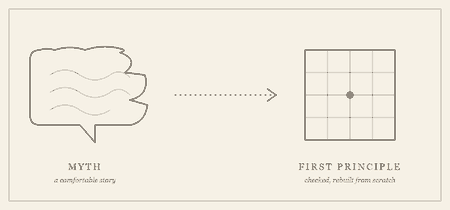
Here’s the setup. Over the past while I’ve been falling down a rabbit hole that connects a Roman emperor’s private journal, a 2,500-year-old Chinese poem about water, the second law of thermodynamics, and a bongo-playing physicist named Richard Feynman who refused to believe anything until he’d rebuilt it himself from scratch. Four wildly different sources — different centuries, different continents, different vocabularies entirely — and somehow they keep circling the same trick: catching yourself believing a comfortable story instead of checking the actual thing.
Myth versus first principles. That’s the thread I’m pulling on.
A few of the questions I’ll be chasing:
Why does the universe seem to prefer mess over order — and what does that actually mean for how hard you should be on yourself when things fall apart? (Thermodynamics has an answer, and it’s oddly comforting.)
The Stoics had a two-item list — “up to me” and “not up to me” — that’s almost insultingly simple. Why is it still so hard to actually live by?
The Tao Te Ching opens by warning that naming a thing means you’ve already started lying to yourself about it. What does water have to do with that?
Feynman’s real first principle wasn’t a physics equation. It was “you must not fool yourself — and you are the easiest person to fool.” What does that look like applied to, say, your actual daily habits?
I don’t have this fully worked out. That’s on purpose. I’m not writing this as someone who’s arrived somewhere and is now reporting back with a tidy conclusion — I’m writing it while I’m still in it, still checking my own assumptions as I go. So instead of one long essay dropped all at once, I’m going to build this out piece by piece, a few days or a week apart, letting each idea breathe before stacking the next one on top.
Think of it less like a finished lecture and more like watching someone take a machine apart on a workbench, one bolt at a time, occasionally holding up a part and going “wait, why is this here?”
My hope is that it stays fun rather than academic — short enough to read with your coffee, but with enough of a hook that you’re still turning it over in your head an hour later. If a section makes you go “huh, I’ve never actually questioned that,” it did its job.
Next up: why order might be the strangest, most temporary thing in the entire universe — and what a melting ice cube has to do with your to-do list.
See you in the next one. Still checking my own math as I write it.
Context and Background: The passage comes from the opening lines of the Tao Te Ching by Laozi. It is foundational to Daoist philosophy. Written over 2,000 years ago, this text explores the nature of existence (Tao). It also examines the interplay between the ineffable and the definable (Name). The philosophical focus is on understanding universal truths and transcending superficial distinctions to achieve harmony with the natural order.
Analogies for “道” (Tao) and “名” (Name): Tao (道): Imagine the Tao as gravity. It governs the universe invisibly and influences everything. Yet, it can’t be fully seen or described. It’s constant but beyond words.
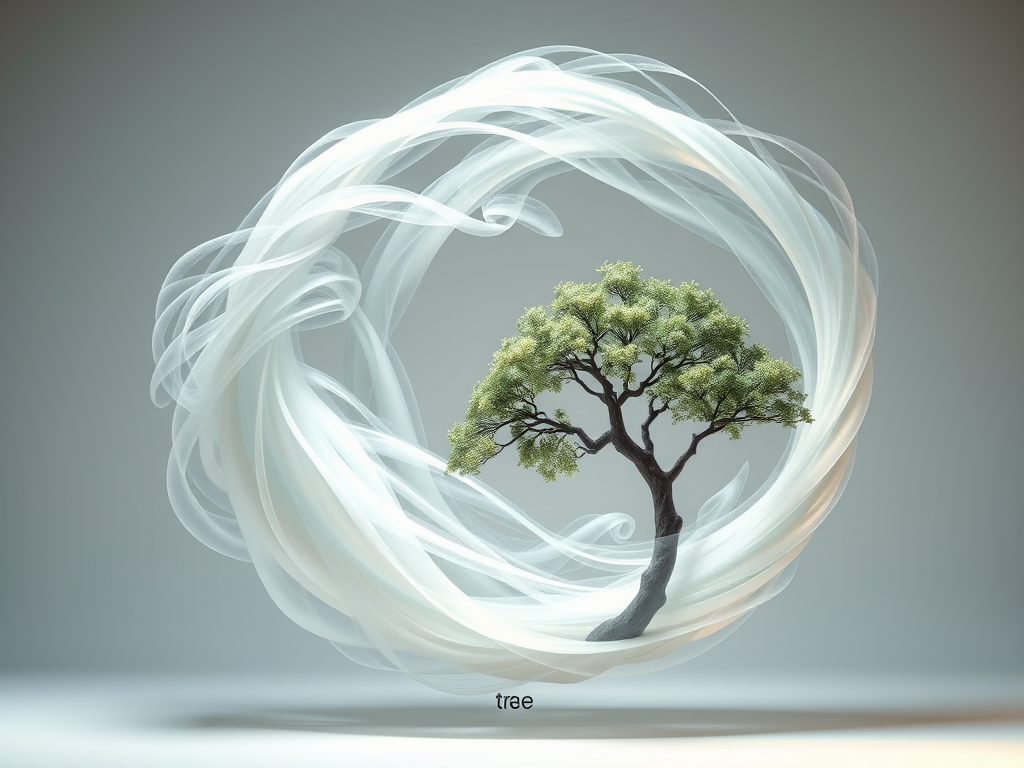
Name (名): Think of “name” as a label, like “tree.” While useful for communication, it does not convey the full essence of a tree. It does not reveal the tree’s life, its connection to the earth, or its role in the ecosystem.
Practical Applications: Letting Go of Labels: Avoid clinging to rigid definitions or judgments. For example, view a “failure” as a step toward learning. This perspective aligns with the principle of transcending superficial “names.”
Balancing Action and Awareness: The contrast between “desire” (actively pursuing goals) and “non-desire” (observing without bias) suggests a balanced approach. In life, this means setting goals while remaining open to change and deeper understanding.
Key Takeaways: The Tao (道): Stands for universal, unchanging truths that can’t be fully articulated. The Name (名): A human tool for categorization, helpful but inherently limiting. Core Wisdom: True understanding comes from letting go of rigid perspectives (non-wanting) while embracing life’s practicalities (wishes).
Daily Life: Practice mindfulness, adaptability, and non-attachment to labels to align with life’s natural flow.
The Tao that can be spoken is not the eternal Tao.
The name that can be named is not the eternal name.
Tao symbolizes the fundamental laws governing the operation of all things in the universe. Yet, any Tao that can be expressed in words is not the true, eternal Tao.
Names are the labels humans assign to things. Still, a clearly defined name does not encapsulate the essence of the thing it describes.
The nameless is the origin of Heaven and Earth; the named is the mother of all things. ‘Nameless’ refers to the state before Heaven and Earth were formed when all was in chaos. ‘Named’ refers to the state after the formation of all things when humans assigned names to understand and distinguish them.
By being free of desires, one observes the profound mysteries of the universe. With desires, one sees only its surface manifestations. Through a state of non-attachment (abandoning subjective thoughts and obsessions), one can grasp the deep truths of the universe. Through attachment (approaching with intentions and desires), one perceives only the superficial aspects.
The two arise from the same source but are named differently; together, they are called the profound. Non-attachment and attachment seem contradictory, but they both stem from the same Tao. This profound wisdom is the key to understanding the mysteries of the universe.
Simplified : Tao: The fundamental principle governing the universe, beyond full articulation. Names: Tools humans use to label and understand things, but they don’t reveal the essence. Observing without craving (non-attachment) reveals deep truths, while observing with want only shows superficial aspects. Though these approaches seem opposite, both lead to Tao and serve as paths to wisdom.
Applications: Tao in Life: Embrace change, follow natural laws, and avoid being overly attached to defining everything. Non-Attachment and Attachment: Let go of preconceived notions to see the world’s essence. Set clear goals and intentions in action. Combining the two balances: rationality with intuition.
The Tao that can be told is not the eternal Tao. The name that can be named is not the eternal name.
The true nature of the Tao (the Way, or universal principle) can’t be fully described or contained by words. Similarly, names are merely labels and do not capture the essence of what they describe. “The nameless is the origin of Heaven and Earth; the named is the mother of all things.”
The formless, nameless Tao signifies the source of all creation. Naming gives structure and individuality to things but is not their ultimate source. “So, free from want, you watch its mystery; caught in wish, you see only its manifestations.”
By letting go of desires and biases, you can grasp the deeper truth of the universe. Yearning binds you to surface-level appearances. “These two emerge from the same source but have different names; together, they are called the profound.”
The opposites (formless vs. form, desire vs. detachment) arise from the same origin, the Tao. This profound interplay of opposites is the gateway to all wisdom.
Interpretation: The passage teaches humility in understanding the universe. It advises observing life with an open, unbiased mind. This approach allows the perception of its deeper mysteries. It also acknowledges the limitations of human concepts like language and names.