Stoic Insights: You Never Fully Arrive

Notes — The Long Approach
The Third Law, as a Way of Living
One law of physics, and what it teaches about the difference between progress and arrival.
Third Law
Absolute zero
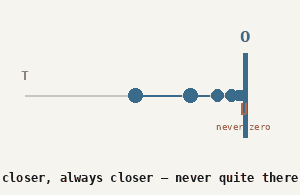
A series of dots along a line getting closer and closer together as they approach a vertical wall labeled 0, but never touching it. A small bracket marks the remaining gap, labeled never zero. Caption below reads: closer, always closer, never quite there.

As a system is cooled toward absolute zero, its entropy approaches a fixed minimum — but absolute zero itself can never be reached in a finite number of steps, only approached more and more closely.

Every real attempt to cool something down runs into the same wall. The first ninety percent of the distance to zero is easy. The next nine percent is harder. The next tenth of a percent takes more energy and precision than everything before it combined — and there is always a next tenth of a percent. Physicists have gotten matter to within a few billionths of a degree of absolute zero. Nobody has ever gotten there, and the math says nobody ever will, no matter how good the equipment gets.

This isn’t a failure of engineering. It’s the shape of the problem itself: each step forward only closes part of what’s left, which means something is always left. Progress and arrival turn out to be different categories, not different amounts of the same thing.

I notice I still slip into treating “good enough for now” as a layover on the way to some future “finished” — as if arrival were still coming, on a longer timeline, instead of admitting that closing the distance is the whole game and always will be.

Stoic reading

The Stoics kept a sharp line between the sage — someone who has fully arrived at wisdom — and the prokopton, the one who is making progress. They talked about the sage constantly and, as far as the record shows, never claimed to have met one. That wasn’t false modesty. It was the honest shape of the thing: virtue is approached, not finished, and you’re still measured by how you’re closing the distance today.

Daoist reading

The Daodejing opens by saying it out loud: 道可道,非常道 — the Dao that can be put into words is not the constant, eternal Dao. Language can gesture at it, circle it, get closer to naming it, but a finite sentence can never equal an infinite thing. The opening line isn’t a warning to stop trying to describe the Way. It’s an admission, right at the start, about what description can and can’t do.

Three takeaways
  1. Getting closer and arriving are different categories, not different amounts of the same thing — don’t wait for the second one before crediting the first.
  2. The last stretch is always the slowest and most expensive. That’s not a sign you’re doing it wrong; it’s the actual shape of the curve.
  3. A system with nowhere left to go would also have nothing left to do. The approach isn’t just the price of the destination — it’s where the motion is.
Continuing the thread

This closes out the loose series pairing each law of thermodynamics with a Stoic and Daoist reading — it opened with the Zeroth and Second Laws together, went deeper on entropy in why order is so strange, filled in the First Law just now, and ends here with the Third. Next: stepping back from the laws one at a time to see what the four of them add up to together — and where this project goes from there. New here? The project’s starting point explains why this site keeps circling back to the same three things.

A question for you: what’s something you keep treating as a problem to finish, that might actually be a distance to keep closing?

此文亦有中文版:《从热力学第三定律看生活之道》。
S → 0 as T → 0 — never zero, always closer

Stoic Insights: Nothing Is Wasted, Only Transformed

Notes — Conservation and Transformation
The First Law, as a Way of Living
One law of physics, and what it teaches about where your effort actually goes.
First Law
Energy conservation
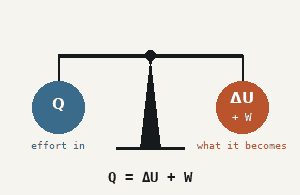
A balance scale, perfectly level: the left pan holds Q, labeled 'effort in', the right pan holds delta U plus W, labeled 'what it becomes'. Caption below reads Q equals delta U plus W.

Energy can neither be created nor destroyed — only transformed from one form to another, or transferred from one place to another.

Nothing you spend simply vanishes. Heat goes into a system, work comes out of it, and the books always balance: ΔU = Q − W. What changes is form — heat becomes motion, motion becomes heat, potential becomes kinetic and back again. The total is conserved even when the shape is unrecognizable.

This is quietly one of the more comforting laws in physics. Effort that seems to disappear — a conversation that went nowhere, a year that felt wasted, a plan that fell apart — didn’t vanish. It converted into something else: a boundary you now hold more clearly, a skill you didn’t notice sharpening, a version of patience you didn’t have before.

I notice I still have to talk myself out of calling certain stretches “wasted” — a job that ended before it went anywhere, months spent on a plan that never launched — before I can honestly ask what that energy became instead.

Stoic reading

Nothing is wasted, only transformed. The Stoic task isn’t to prevent loss — loss in the old form is guaranteed — it’s to notice what the energy became, and to keep directing it toward what’s actually yours to control.

Daoist reading

The Dao is constant transformation, nothing gained or lost — like Zhuangzi’s cook Ding, whose blade cut up thousands of oxen over nineteen years yet still looks freshly honed, because he follows the natural seams and hollows of the joint instead of hacking through bone. Move with the grain of things and nothing is worn away; force against it, and that’s where the wear comes from.

Three takeaways
  1. Effort doesn’t disappear — it converts. The honest question isn’t “was it wasted,” it’s “what did it become.”
  2. You can’t create energy from nothing either — rest and input aren’t optional extras, they’re where the next form of output comes from.
  3. The ledger always balances. What looks like a closed loop of loss is usually a transformation you haven’t traced yet.
Continuing the thread

This is part of a loose series pairing each law of thermodynamics with a Stoic and Daoist reading — it opened with the Zeroth and Second Laws together, went deeper on entropy this week in why order is so strange, and now fills in the First. Next: the Third Law, and what’s left to say about a system once it has nowhere left to lose energy to. New here? The project’s starting point explains why this site keeps circling back to the same three things.

A question for you: think of something that felt like wasted effort. What form did that energy actually take?

此文亦有中文版:《从热力学第一定律看生活之道》。

ΔU = Q − W — nothing is lost, only changed