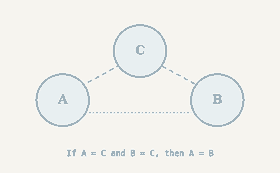
If A is in equilibrium with C, and B is in equilibrium with C, then A and B are in equilibrium with each other.
There’s a law of thermodynamics most people have never heard of, because it seems too obvious to name. It’s called the zeroth law, and it says exactly that. Three things left in contact settle to the same state — quietly, with no force required. It’s the law that makes temperature possible at all. It’s why a thermometer works.
Calibrate yourself against something stable, rather than reacting differently to every person or situation. A common measure of reality, not a moving target.
Wu wei — the stillness of water finding its own level, without anyone pushing it there.
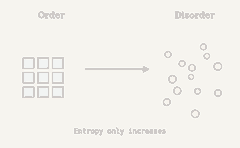
Entropy increases. Left alone, things drift from order toward disorder, and that drift never reverses.
Where the zeroth law is still, the second law moves. Order costs energy to maintain, and the moment you stop paying, it dissipates. This is the current you’re always swimming in.
Decay isn’t a personal failure — it’s the default setting of everything. You can only choose, deliberately, what you spend your energy holding together before it disperses.
The river that only flows one way — wisdom is moving with the current instead of exhausting yourself fighting it.
- Equilibrium is the calm you return to — a reference point, not a permanent state.
- Entropy is the current you’re always in — change is guaranteed, direction is not optional.
- Order is local and temporary. It exists only because someone spent energy maintaining it.
- The practical move: spend that energy on what actually holds order together, and stop treating drift as failure.
A question for you: what’s one thing in your life you’re spending energy to hold together right now — and is it worth it?
此文亦有中文版:《从热力学第零定律与第二定律看生活之道》。


Pingback: Stoic Insights: Nothing Is Wasted, Only Transformed | Always Be Confident
Pingback: Stoic Insights: You Never Fully Arrive | Always Be Confident