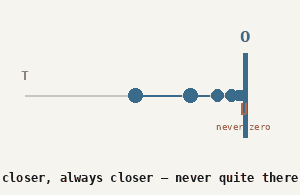
As a system is cooled toward absolute zero, its entropy approaches a fixed minimum — but absolute zero itself can never be reached in a finite number of steps, only approached more and more closely.
Every real attempt to cool something down runs into the same wall. The first ninety percent of the distance to zero is easy. The next nine percent is harder. The next tenth of a percent takes more energy and precision than everything before it combined — and there is always a next tenth of a percent. Physicists have gotten matter to within a few billionths of a degree of absolute zero. Nobody has ever gotten there, and the math says nobody ever will, no matter how good the equipment gets.
This isn’t a failure of engineering. It’s the shape of the problem itself: each step forward only closes part of what’s left, which means something is always left. Progress and arrival turn out to be different categories, not different amounts of the same thing.
I notice I still slip into treating “good enough for now” as a layover on the way to some future “finished” — as if arrival were still coming, on a longer timeline, instead of admitting that closing the distance is the whole game and always will be.
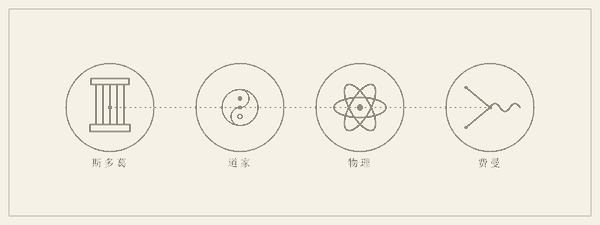
The Stoics kept a sharp line between the sage — someone who has fully arrived at wisdom — and the prokopton, the one who is making progress. They talked about the sage constantly and, as far as the record shows, never claimed to have met one. That wasn’t false modesty. It was the honest shape of the thing: virtue is approached, not finished, and you’re still measured by how you’re closing the distance today.
The Daodejing opens by saying it out loud: 道可道,非常道 — the Dao that can be put into words is not the constant, eternal Dao. Language can gesture at it, circle it, get closer to naming it, but a finite sentence can never equal an infinite thing. The opening line isn’t a warning to stop trying to describe the Way. It’s an admission, right at the start, about what description can and can’t do.
- Getting closer and arriving are different categories, not different amounts of the same thing — don’t wait for the second one before crediting the first.
- The last stretch is always the slowest and most expensive. That’s not a sign you’re doing it wrong; it’s the actual shape of the curve.
- A system with nowhere left to go would also have nothing left to do. The approach isn’t just the price of the destination — it’s where the motion is.
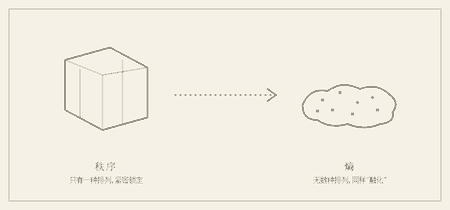
This closes out the loose series pairing each law of thermodynamics with a Stoic and Daoist reading — it opened with the Zeroth and Second Laws together, went deeper on entropy in why order is so strange, filled in the First Law just now, and ends here with the Third. Next: stepping back from the laws one at a time to see what the four of them add up to together — and where this project goes from there. New here? The project’s starting point explains why this site keeps circling back to the same three things.
A question for you: what’s something you keep treating as a problem to finish, that might actually be a distance to keep closing?
此文亦有中文版:《从热力学第三定律看生活之道》。