Stoic Insights: Things Don’t Stop on Their Own

Notes — Laws of Motion, Part 1
Newton’s First Law, as a Way of Living
One law of motion, and what it teaches about habits, momentum, and the forces we’ve stopped noticing.
Newton’s First Law
Inertia
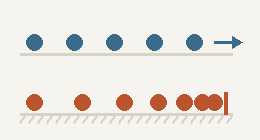
Two rows of dots. Top row: evenly spaced blue dots on a smooth line with an arrow, still moving. Bottom row: orange dots bunching closer together on a rough, hatched line and ending at a stop bar.

A body at rest stays at rest, and a body in motion keeps moving in a straight line at a steady speed, unless a net outside force acts on it.

Roll a ball across a table and it stops. For nearly two thousand years, that looked like the obvious lesson: things come to rest on their own, and motion needs something to keep pushing. Then Galileo and Newton noticed that the ball isn’t stopping by itself. Something is stopping it — friction, air — a force so constant that we stopped counting it as a force at all. Take it away (on ice, on an air-hockey table, in space) and the ball just keeps going.

That flips the first principle. Stillness isn’t the natural default, and neither is motion. The default is persistence: whatever state a thing is in, it stays in until something acts on it.

I notice I still treat my own stalled projects as if they stopped by themselves — as if the stillness were natural — instead of asking what is actually holding them there. And I do the mirror-image thing with my routines: nobody is pushing me to keep running them, I’m just not being stopped. (Physics is only a metaphor here, of course — a habit isn’t a billiard ball — but the metaphor has been more useful to me than most advice about willpower.)

Stoic reading

In his Discourses (2.18, on how to struggle against impressions), Epictetus says every habit and faculty is confirmed and strengthened by the corresponding acts — walking by walking, running by running — and the same goes for the habits we’d rather lose: each time we give in to anger or greed, we’ve added to its momentum. His answer isn’t one heroic overthrow; it’s steady, repeated resistance. Read in a physicist’s key (my gloss, not his words): the state persists, and only a force applied on purpose, again and again, changes it.

Daoist reading

Chapter 15 of the Daodejing asks two questions: 孰能浊以静之徐清?孰能安以动之徐生? — who can let muddy water settle until it slowly clears? Who can stir what has settled, gently, until it slowly comes alive? Both directions of change, from motion to rest and from rest to motion, are described as slow and unforced, and both are posed as hard. The Dao doesn’t deny inertia; it respects it. Don’t shake the jar, don’t shove the boulder — find the small, steady nudge and give it time.

Three takeaways
  1. Persistence is the default, not stillness and not motion. What you’re doing right now is what you’ll keep doing until something changes it.
  2. When something stops, look for the force, not the flaw. Friction is a force you’ve stopped noticing — and so are the routines, expectations, and fears that hold a project still.
  3. Change needs a net force, and it doesn’t have to be dramatic. A small push applied steadily beats a heroic shove that fades — though how much a given push actually changes things turns out to depend on something we haven’t talked about yet.
Continuing the thread

This opens a new series pairing Newton’s three laws of motion with a Stoic and Daoist reading — the sequel to the thermodynamics series, which wrapped up in The Four Laws, Taken Together. If this one felt familiar, it may be because thermodynamics already said something close about why order has to be maintained and, in the Third Law, why closing a distance isn’t the same as arriving. Next: the Second Law of motion, and why the same push moves a pebble but barely nudges a boulder — and what that says about the weight of whatever you’re carrying. New here? The project’s starting point explains why this site keeps circling back to the same three things.

A question for you: what’s one thing in your life that has stopped moving — and what’s the invisible “friction” actually holding it there?

此文亦有中文版:《从牛顿第一定律看生活之道》。

net force = 0 — then nothing changes, and nothing stops by itself

61. How to Live & Die ?

On the topic of how to live and die well. We’ll be discussing the teachings of Stoicism and Taoism on how to approach life and death with contentment and equanimity. 

Stoicism teaches us to let go of our desires and focus on living each day as if it were a complete life. This means accepting our fate, including the inevitability of death, and approaching it with gladness rather than sadness. By accepting our circumstances and aligning our desires with them, we can avoid bitterness and unhappiness that come from resisting what we cannot change. 

The importance of living without resentment or unwillingness, even when circumstances demand something of us that we might not otherwise choose. By doing so willingly, we can avoid unhappiness and bitterness that come from resisting what we cannot change. 

Our ability to live well depends not on the length of our lives, but on the quality of our minds. By cultivating a calm and virtuous mind, we can find contentment in life and face death with equanimity. 

From a Taoist point of view, the key to happiness is focusing on the present and living each day as a complete life, rather than constantly seeking more or desiring what we cannot have. The ideal of dying well is also emphasised, which echoes the Taoist belief in accepting the natural flow of life and death without fear or resistance. 

To die well means dying gladly, as Seneca, a Stoic philosopher, writes; It means ceasing to desire what we desired when we were younger and focusing on putting an end to our chronic ills. Seneca writes that he tries to live every day as if it were a complete life, not snatching it up as if it were his last, but regarding it as if it might even be his last. 

The key to dying well is to never do anything unwillingly, according to Seneca. One who takes their orders gladly escapes the bitterest part of slavery, doing what one does not want to do. To do something under orders is not unhappy, but one is unhappy who does something against their will. Therefore we must set our minds in order to desire whatever is demanded of us by circumstances, and reflect upon our end without sadness. 

To have lived long enough depends neither upon our years nor upon our days, but upon our minds. Seneca writes that he has lived long enough and has had his fill; he awaits death. 

In conclusion, the teachings of Stoicism and Taoism encourage us to find contentment and fulfilment in the present moment, rather than constantly striving for more or worrying about the future. By accepting our fate and aligning our desires with it, we can approach life and death with equanimity and die gladly.  

How to Live & Die ? 

Stoic teaches us how to live & die well, to let go of your desires & focus on living each day as if it were a complete life. Accepting your fate, including the inevitability of death, & to approach it with gladness rather than sadness. 

The importance of living with resentment or unwillingness, even when circumstances demand something of us that we might not otherwise choose. Thereby accepting our circumstances & aligning our desire with them, we can avoid the bitterness & unhappiness that come from resisting what we cannot change. 

Our Ability to live well depends not on the length of our lives, but on the quality of our minds. So by cultivating a calm & virtuous mind, we can find contentment in life & face death with equanimity. 

From a Taoist point of view, focusing on the present & living each day as a complete life is the key to happiness, rather than constantly seeking more or desiring what we cannot have. The ideal of dying well, is also emphasised, which echoes the Taoist belief in accepting the nature flow of life & death without fear or resistance.  

We can avoid unhappiness & bitterness by accepting what is demanded of us by circumstances & doing so willingly, rather than resisting or rebelling against it.  

Overall it is about finding contentment & fulfilment in the present moment, rather than constantly striving for more or worrying about the future.  

On Meeting Death Cheerfully  

Let us cease to desire that which we have been desiring. I, at least, am doing this in my old age, I have ceased to desire what I desired when a boy. To this single end my days and my nights are passed; this is my task, this the object of my thoughts, – to put an end to my chronic ills. I am endeavouring to live every day as if it were a complete life; I do not indeed snatch it up as if it were my last; I do regard it, however as if it might even be my last.  

The present letter is written to you with this in mind, – as if death were about to call me away in the very act of writing. I am ready to depart, and I shall enjoy life just because I am not over-anxious as to the future date of my departure.   

Before I became old I tried to live well; now that I am old, I shall try to die well; but dying well means dying gladly; See to it that you never do anything unwillingly.  

That which is bound to be a necessity if you rebel, is not a necessity if you desire it. This is what I mean: one who takes their orders gladly, escapes the bitterest part of slavery, – doing what one does not want to do. The person who does something under orders is not unhappy; one is unhappy who does something against their will. Let us therefore so set our minds in order that we may desire whatever is demanded of us by circumstances, and above all that we may reflect upon our end without sadness.  

We must make ready for death before we make ready for life. Life is well enough furnished, but we are too greedy with regard to its furnishings; something always seems to us lacking, and will always seem lacking. To have lived long enough depends neither upon our years nor upon our days, but upon our minds. I have lived my dear friend Lucilius, long enough. I have had my fill, I await death.  

Farewell, Seneca, StoicTaoist