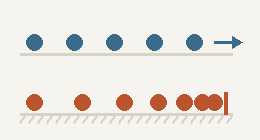
A body at rest stays at rest, and a body in motion keeps moving in a straight line at a steady speed, unless a net outside force acts on it.
Roll a ball across a table and it stops. For nearly two thousand years, that looked like the obvious lesson: things come to rest on their own, and motion needs something to keep pushing. Then Galileo and Newton noticed that the ball isn’t stopping by itself. Something is stopping it — friction, air — a force so constant that we stopped counting it as a force at all. Take it away (on ice, on an air-hockey table, in space) and the ball just keeps going.
That flips the first principle. Stillness isn’t the natural default, and neither is motion. The default is persistence: whatever state a thing is in, it stays in until something acts on it.
I notice I still treat my own stalled projects as if they stopped by themselves — as if the stillness were natural — instead of asking what is actually holding them there. And I do the mirror-image thing with my routines: nobody is pushing me to keep running them, I’m just not being stopped. (Physics is only a metaphor here, of course — a habit isn’t a billiard ball — but the metaphor has been more useful to me than most advice about willpower.)
In his Discourses (2.18, on how to struggle against impressions), Epictetus says every habit and faculty is confirmed and strengthened by the corresponding acts — walking by walking, running by running — and the same goes for the habits we’d rather lose: each time we give in to anger or greed, we’ve added to its momentum. His answer isn’t one heroic overthrow; it’s steady, repeated resistance. Read in a physicist’s key (my gloss, not his words): the state persists, and only a force applied on purpose, again and again, changes it.
Chapter 15 of the Daodejing asks two questions: 孰能浊以静之徐清?孰能安以动之徐生? — who can let muddy water settle until it slowly clears? Who can stir what has settled, gently, until it slowly comes alive? Both directions of change, from motion to rest and from rest to motion, are described as slow and unforced, and both are posed as hard. The Dao doesn’t deny inertia; it respects it. Don’t shake the jar, don’t shove the boulder — find the small, steady nudge and give it time.
- Persistence is the default, not stillness and not motion. What you’re doing right now is what you’ll keep doing until something changes it.
- When something stops, look for the force, not the flaw. Friction is a force you’ve stopped noticing — and so are the routines, expectations, and fears that hold a project still.
- Change needs a net force, and it doesn’t have to be dramatic. A small push applied steadily beats a heroic shove that fades — though how much a given push actually changes things turns out to depend on something we haven’t talked about yet.
This opens a new series pairing Newton’s three laws of motion with a Stoic and Daoist reading — the sequel to the thermodynamics series, which wrapped up in The Four Laws, Taken Together. If this one felt familiar, it may be because thermodynamics already said something close about why order has to be maintained and, in the Third Law, why closing a distance isn’t the same as arriving. Next: the Second Law of motion, and why the same push moves a pebble but barely nudges a boulder — and what that says about the weight of whatever you’re carrying. New here? The project’s starting point explains why this site keeps circling back to the same three things.
A question for you: what’s one thing in your life that has stopped moving — and what’s the invisible “friction” actually holding it there?
此文亦有中文版:《从牛顿第一定律看生活之道》。

