Stoic Insights: You Never Fully Arrive

Notes — The Long Approach
The Third Law, as a Way of Living
One law of physics, and what it teaches about the difference between progress and arrival.
Third Law
Absolute zero
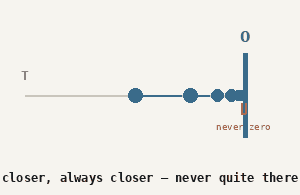
A series of dots along a line getting closer and closer together as they approach a vertical wall labeled 0, but never touching it. A small bracket marks the remaining gap, labeled never zero. Caption below reads: closer, always closer, never quite there.

As a system is cooled toward absolute zero, its entropy approaches a fixed minimum — but absolute zero itself can never be reached in a finite number of steps, only approached more and more closely.

Every real attempt to cool something down runs into the same wall. The first ninety percent of the distance to zero is easy. The next nine percent is harder. The next tenth of a percent takes more energy and precision than everything before it combined — and there is always a next tenth of a percent. Physicists have gotten matter to within a few billionths of a degree of absolute zero. Nobody has ever gotten there, and the math says nobody ever will, no matter how good the equipment gets.

This isn’t a failure of engineering. It’s the shape of the problem itself: each step forward only closes part of what’s left, which means something is always left. Progress and arrival turn out to be different categories, not different amounts of the same thing.

I notice I still slip into treating “good enough for now” as a layover on the way to some future “finished” — as if arrival were still coming, on a longer timeline, instead of admitting that closing the distance is the whole game and always will be.

Stoic reading

The Stoics kept a sharp line between the sage — someone who has fully arrived at wisdom — and the prokopton, the one who is making progress. They talked about the sage constantly and, as far as the record shows, never claimed to have met one. That wasn’t false modesty. It was the honest shape of the thing: virtue is approached, not finished, and you’re still measured by how you’re closing the distance today.

Daoist reading

The Daodejing opens by saying it out loud: 道可道,非常道 — the Dao that can be put into words is not the constant, eternal Dao. Language can gesture at it, circle it, get closer to naming it, but a finite sentence can never equal an infinite thing. The opening line isn’t a warning to stop trying to describe the Way. It’s an admission, right at the start, about what description can and can’t do.

Three takeaways
  1. Getting closer and arriving are different categories, not different amounts of the same thing — don’t wait for the second one before crediting the first.
  2. The last stretch is always the slowest and most expensive. That’s not a sign you’re doing it wrong; it’s the actual shape of the curve.
  3. A system with nowhere left to go would also have nothing left to do. The approach isn’t just the price of the destination — it’s where the motion is.
Continuing the thread

This closes out the loose series pairing each law of thermodynamics with a Stoic and Daoist reading — it opened with the Zeroth and Second Laws together, went deeper on entropy in why order is so strange, filled in the First Law just now, and ends here with the Third. Next: stepping back from the laws one at a time to see what the four of them add up to together — and where this project goes from there. New here? The project’s starting point explains why this site keeps circling back to the same three things.

A question for you: what’s something you keep treating as a problem to finish, that might actually be a distance to keep closing?

此文亦有中文版:《从热力学第三定律看生活之道》。

S → 0 as T → 0 — never zero, always closer

Chasing First Principles: A Journey Through Stoicism, Daoism, and Physics (In Progress)

Four ink-line icons connected by a dotted thread: a Stoic column, a yin-yang, an atom, and a Feynman diagram

Also available in: 中文

I ruined a dinner party recently by asking a simple question: how much of what you believe did you actually work out yourself, and how much did you just inherit?

Nobody had a good answer. Neither did I. That question is the whole reason this series exists.

Here’s the setup. Over the past while I’ve been falling down a rabbit hole that connects a Roman emperor’s private journal, a 2,500-year-old Chinese poem about water, the second law of thermodynamics, and a bongo-playing physicist named Richard Feynman who refused to believe anything until he’d rebuilt it himself from scratch. Four wildly different sources — different centuries, different continents, different vocabularies entirely — and somehow they keep circling the same trick: catching yourself believing a comfortable story instead of checking the actual thing.

Myth versus first principles. That’s the thread I’m pulling on.

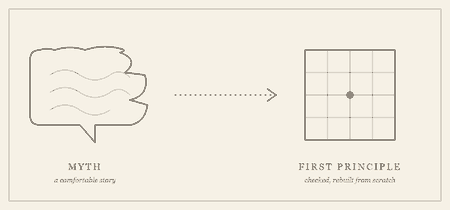
Left: a cracked speech bubble labeled MYTH, a comfortable story. Right: a clean grid labeled FIRST PRINCIPLE, checked and rebuilt from scratch.

A few of the questions I’ll be chasing:

  • Why does the universe seem to prefer mess over order — and what does that actually mean for how hard you should be on yourself when things fall apart? (Thermodynamics has an answer, and it’s oddly comforting.)
  • The Stoics had a two-item list — “up to me” and “not up to me” — that’s almost insultingly simple. Why is it still so hard to actually live by?
  • The Tao Te Ching opens by warning that naming a thing means you’ve already started lying to yourself about it. What does water have to do with that?
  • Feynman’s real first principle wasn’t a physics equation. It was “you must not fool yourself — and you are the easiest person to fool.” What does that look like applied to, say, your actual daily habits?

I don’t have this fully worked out. That’s on purpose. I’m not writing this as someone who’s arrived somewhere and is now reporting back with a tidy conclusion — I’m writing it while I’m still in it, still checking my own assumptions as I go. So instead of one long essay dropped all at once, I’m going to build this out piece by piece, a few days or a week apart, letting each idea breathe before stacking the next one on top.

Think of it less like a finished lecture and more like watching someone take a machine apart on a workbench, one bolt at a time, occasionally holding up a part and going “wait, why is this here?”

My hope is that it stays fun rather than academic — short enough to read with your coffee, but with enough of a hook that you’re still turning it over in your head an hour later. If a section makes you go “huh, I’ve never actually questioned that,” it did its job.

Next up: why order might be the strangest, most temporary thing in the entire universe — and what a melting ice cube has to do with your to-do list.

See you in the next one. Still checking my own math as I write it.