Stoic Insights: Nothing Is Wasted, Only Transformed

Notes — Conservation and Transformation
The First Law, as a Way of Living
One law of physics, and what it teaches about where your effort actually goes.
First Law
Energy conservation
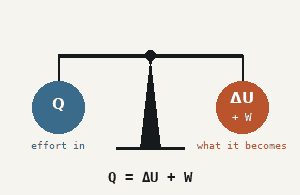
A balance scale, perfectly level: the left pan holds Q, labeled 'effort in', the right pan holds delta U plus W, labeled 'what it becomes'. Caption below reads Q equals delta U plus W.

Energy can neither be created nor destroyed — only transformed from one form to another, or transferred from one place to another.

Nothing you spend simply vanishes. Heat goes into a system, work comes out of it, and the books always balance: ΔU = Q − W. What changes is form — heat becomes motion, motion becomes heat, potential becomes kinetic and back again. The total is conserved even when the shape is unrecognizable.

This is quietly one of the more comforting laws in physics. Effort that seems to disappear — a conversation that went nowhere, a year that felt wasted, a plan that fell apart — didn’t vanish. It converted into something else: a boundary you now hold more clearly, a skill you didn’t notice sharpening, a version of patience you didn’t have before.

I notice I still have to talk myself out of calling certain stretches “wasted” — a job that ended before it went anywhere, months spent on a plan that never launched — before I can honestly ask what that energy became instead.

Stoic reading

Nothing is wasted, only transformed. The Stoic task isn’t to prevent loss — loss in the old form is guaranteed — it’s to notice what the energy became, and to keep directing it toward what’s actually yours to control.

Daoist reading

The Dao is constant transformation, nothing gained or lost — like Zhuangzi’s cook Ding, whose blade cut up thousands of oxen over nineteen years yet still looks freshly honed, because he follows the natural seams and hollows of the joint instead of hacking through bone. Move with the grain of things and nothing is worn away; force against it, and that’s where the wear comes from.

Three takeaways
  1. Effort doesn’t disappear — it converts. The honest question isn’t “was it wasted,” it’s “what did it become.”
  2. You can’t create energy from nothing either — rest and input aren’t optional extras, they’re where the next form of output comes from.
  3. The ledger always balances. What looks like a closed loop of loss is usually a transformation you haven’t traced yet.
Continuing the thread

This is part of a loose series pairing each law of thermodynamics with a Stoic and Daoist reading — it opened with the Zeroth and Second Laws together, went deeper on entropy this week in why order is so strange, and now fills in the First. Next: the Third Law, and what’s left to say about a system once it has nowhere left to lose energy to. New here? The project’s starting point explains why this site keeps circling back to the same three things.

A question for you: think of something that felt like wasted effort. What form did that energy actually take?

此文亦有中文版:《从热力学第一定律看生活之道》。

ΔU = Q − W — nothing is lost, only changed

Why “Order” Might Be the Strangest Thing in the Whole Universe

Four ink-line icons connected by a dotted thread: a Stoic column, a yin-yang, an atom, and a Feynman diagram

Also available in: 中文 · Part 2 of the series — start with Chasing First Principles

Leave an ice cube on the counter and walk away. Come back in an hour: puddle. Now try the reverse — leave a puddle on the counter and come back hoping for an ice cube. You already know how that goes.

That little asymmetry is one of the strangest facts in physics, and almost nobody stops to notice it’s strange. Ice melts into water constantly. Water never un-melts into ice on its own. Why not? Nothing in the basic laws of motion forbids it — if you filmed the melting and played it backwards, every individual collision between molecules would still be perfectly legal physics. And yet one direction happens constantly, in every kitchen on Earth, and the other direction has never once been observed. Not once, ever.

The myth: mess is a malfunction

Here’s the story almost everyone quietly believes: things are supposed to stay tidy, and mess is what happens when something goes wrong — you got lazy, you got busy, you dropped the ball.

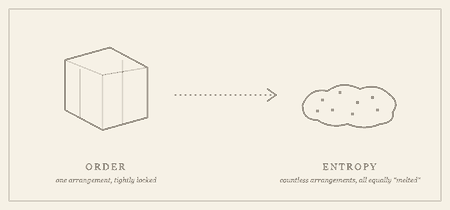
The second law of thermodynamics says this is backwards. Entropy — roughly, the number of ways a system’s insides could be rearranged and still look the same from the outside — increases by default, always, in any closed system. A melted puddle has vastly more ways to arrange its molecules than a neatly stacked ice crystal does, so left alone, the system drifts toward the arrangement with more options. Not because anything is broken. Because “more options” is simply where things end up if nothing is actively fighting to keep them elsewhere.

Left: an ice cube labeled ORDER, one arrangement tightly locked. Right: a scattered puddle labeled ENTROPY, countless arrangements all equally melted.

This isn’t a minor lab curiosity. It’s arguably why time has a direction at all. You remember yesterday and not tomorrow because yesterday was, on average, a slightly more ordered arrangement of the universe than today. The arrow of time and the arrow of “things getting messier” may be the same arrow.

The first principle: order is rented, not owned

So flip the myth. Order was never the default setting anyone owes you. It’s the rare, expensive exception — a candle flame holding its shape against a universe that would honestly rather it didn’t.

Your desk doesn’t get messy because you failed. It gets messy because messy is the direction everything drifts unless energy is spent to stop it, and you had other things to spend energy on this week. Your to-do list doesn’t pile up because you’re bad at your job. Fifty small demands on your attention have vastly more ways to sit in “unsorted chaos” than in “clean and ranked,” so unsorted chaos is where they’ll sit unless someone keeps paying the entropy tax to hold them in a tidier arrangement.

Once you see it this way, effort stops looking like proof that something’s wrong and starts looking like what it actually is: the only thing standing between any ordered system and the much larger pile of disordered ones it could collapse into. Maintaining a body, a room, a relationship, a project — none of it is a one-time achievement. It’s a subscription. The moment you stop paying, entropy doesn’t punish you. It just resumes doing what it does by default.

The part that should make you wonder

Here’s where it gets genuinely strange, not just useful: nobody actually knows why the universe started in such a low-entropy, highly-ordered state in the first place — the state everything has been sliding away from ever since. It’s one of the deepest open questions in cosmology. We can describe the slide beautifully. We’re still fairly in the dark on why the starting line was set so far uphill.

So the next time your inbox is a disaster or your room needs sorting again for the hundredth time, you’re not failing some test of adulthood. You’re watching the most reliable law in physics do exactly what it always does — and getting a small, personal reminder that you’re standing, briefly, in a very unlikely and very temporary pocket of order, in a universe that is, on the whole, still trying to figure out why it bothered being ordered at all.

Next up: the Stoics had a two-column list — “up to me” and “not up to me” — that sounds almost insultingly simple. Given how relentlessly the universe drifts toward mess, why is actually living by that list still so hard?

Still checking my own math as I write it.