Chasing First Principles: A Journey Through Stoicism, Daoism, and Physics (In Progress)

Four ink-line icons connected by a dotted thread: a Stoic column, a yin-yang, an atom, and a Feynman diagram

Also available in: 中文

I ruined a dinner party recently by asking a simple question: how much of what you believe did you actually work out yourself, and how much did you just inherit?

Nobody had a good answer. Neither did I. That question is the whole reason this series exists.

Here’s the setup. Over the past while I’ve been falling down a rabbit hole that connects a Roman emperor’s private journal, a 2,500-year-old Chinese poem about water, the second law of thermodynamics, and a bongo-playing physicist named Richard Feynman who refused to believe anything until he’d rebuilt it himself from scratch. Four wildly different sources — different centuries, different continents, different vocabularies entirely — and somehow they keep circling the same trick: catching yourself believing a comfortable story instead of checking the actual thing.

Myth versus first principles. That’s the thread I’m pulling on.
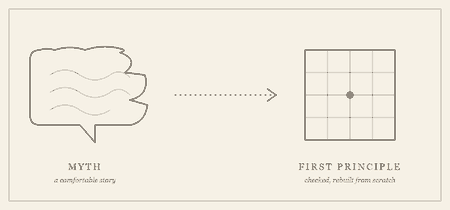
Left: a cracked speech bubble labeled MYTH, a comfortable story. Right: a clean grid labeled FIRST PRINCIPLE, checked and rebuilt from scratch.

A few of the questions I’ll be chasing:

  • Why does the universe seem to prefer mess over order — and what does that actually mean for how hard you should be on yourself when things fall apart? (Thermodynamics has an answer, and it’s oddly comforting.)
  • The Stoics had a two-item list — “up to me” and “not up to me” — that’s almost insultingly simple. Why is it still so hard to actually live by?
  • The Tao Te Ching opens by warning that naming a thing means you’ve already started lying to yourself about it. What does water have to do with that?
  • Feynman’s real first principle wasn’t a physics equation. It was “you must not fool yourself — and you are the easiest person to fool.” What does that look like applied to, say, your actual daily habits?

I don’t have this fully worked out. That’s on purpose. I’m not writing this as someone who’s arrived somewhere and is now reporting back with a tidy conclusion — I’m writing it while I’m still in it, still checking my own assumptions as I go. So instead of one long essay dropped all at once, I’m going to build this out piece by piece, a few days or a week apart, letting each idea breathe before stacking the next one on top.

Think of it less like a finished lecture and more like watching someone take a machine apart on a workbench, one bolt at a time, occasionally holding up a part and going “wait, why is this here?”

My hope is that it stays fun rather than academic — short enough to read with your coffee, but with enough of a hook that you’re still turning it over in your head an hour later. If a section makes you go “huh, I’ve never actually questioned that,” it did its job.

Next up: why order might be the strangest, most temporary thing in the entire universe — and what a melting ice cube has to do with your to-do list.

See you in the next one. Still checking my own math as I write it.
The Zeroth and Second Laws, as a Way of Living

Notes — Equilibrium to Entropy
The Zeroth and Second Laws, as a Way of Living
Two laws of physics, and what they teach about staying steady versus accepting change.
Zeroth Law
Shared equilibrium
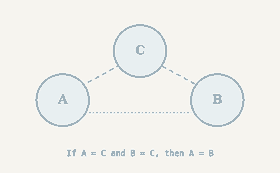
Diagram of three circles A, C, B showing that if A equals C and B equals C, then A equals B

If A is in equilibrium with C, and B is in equilibrium with C, then A and B are in equilibrium with each other.

There’s a law of thermodynamics most people have never heard of, because it seems too obvious to name. It’s called the zeroth law, and it says exactly that. Three things left in contact settle to the same state — quietly, with no force required. It’s the law that makes temperature possible at all. It’s why a thermometer works.

Stoic reading

Calibrate yourself against something stable, rather than reacting differently to every person or situation. A common measure of reality, not a moving target.

Daoist reading

Wu wei — the stillness of water finding its own level, without anyone pushing it there.

Second Law
Directional change
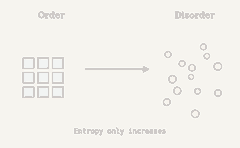
Diagram showing ordered squares on the left transitioning to scattered disordered dots on the right, labeled order and disorder

Entropy increases. Left alone, things drift from order toward disorder, and that drift never reverses.

Where the zeroth law is still, the second law moves. Order costs energy to maintain, and the moment you stop paying, it dissipates. This is the current you’re always swimming in.

Stoic reading

Decay isn’t a personal failure — it’s the default setting of everything. You can only choose, deliberately, what you spend your energy holding together before it disperses.

Daoist reading

The river that only flows one way — wisdom is moving with the current instead of exhausting yourself fighting it.

Where they meet
  1. Equilibrium is the calm you return to — a reference point, not a permanent state.
  2. Entropy is the current you’re always in — change is guaranteed, direction is not optional.
  3. Order is local and temporary. It exists only because someone spent energy maintaining it.
  4. The practical move: spend that energy on what actually holds order together, and stop treating drift as failure.

A question for you: what’s one thing in your life you’re spending energy to hold together right now — and is it worth it?

此文亦有中文版:《从热力学第零定律与第二定律看生活之道》。

k log W — order is rare, but not impossible