Also available in: 中文 · Part 2 of the series — start with Chasing First Principles
Leave an ice cube on the counter and walk away. Come back in an hour: puddle. Now try the reverse — leave a puddle on the counter and come back hoping for an ice cube. You already know how that goes.
That little asymmetry is one of the strangest facts in physics, and almost nobody stops to notice it’s strange. Ice melts into water constantly. Water never un-melts into ice on its own. Why not? Nothing in the basic laws of motion forbids it — if you filmed the melting and played it backwards, every individual collision between molecules would still be perfectly legal physics. And yet one direction happens constantly, in every kitchen on Earth, and the other direction has never once been observed. Not once, ever.
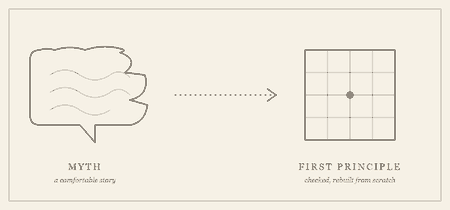
The myth: mess is a malfunction
Here’s the story almost everyone quietly believes: things are supposed to stay tidy, and mess is what happens when something goes wrong — you got lazy, you got busy, you dropped the ball.
The second law of thermodynamics says this is backwards. Entropy — roughly, the number of ways a system’s insides could be rearranged and still look the same from the outside — increases by default, always, in any closed system. A melted puddle has vastly more ways to arrange its molecules than a neatly stacked ice crystal does, so left alone, the system drifts toward the arrangement with more options. Not because anything is broken. Because “more options” is simply where things end up if nothing is actively fighting to keep them elsewhere.
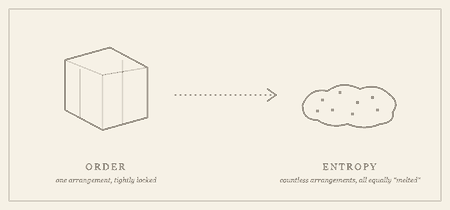
This isn’t a minor lab curiosity. It’s arguably why time has a direction at all. You remember yesterday and not tomorrow because yesterday was, on average, a slightly more ordered arrangement of the universe than today. The arrow of time and the arrow of “things getting messier” may be the same arrow.
The first principle: order is rented, not owned
So flip the myth. Order was never the default setting anyone owes you. It’s the rare, expensive exception — a candle flame holding its shape against a universe that would honestly rather it didn’t.
Your desk doesn’t get messy because you failed. It gets messy because messy is the direction everything drifts unless energy is spent to stop it, and you had other things to spend energy on this week. Your to-do list doesn’t pile up because you’re bad at your job. Fifty small demands on your attention have vastly more ways to sit in “unsorted chaos” than in “clean and ranked,” so unsorted chaos is where they’ll sit unless someone keeps paying the entropy tax to hold them in a tidier arrangement.
Once you see it this way, effort stops looking like proof that something’s wrong and starts looking like what it actually is: the only thing standing between any ordered system and the much larger pile of disordered ones it could collapse into. Maintaining a body, a room, a relationship, a project — none of it is a one-time achievement. It’s a subscription. The moment you stop paying, entropy doesn’t punish you. It just resumes doing what it does by default.
The part that should make you wonder
Here’s where it gets genuinely strange, not just useful: nobody actually knows why the universe started in such a low-entropy, highly-ordered state in the first place — the state everything has been sliding away from ever since. It’s one of the deepest open questions in cosmology. We can describe the slide beautifully. We’re still fairly in the dark on why the starting line was set so far uphill.
So the next time your inbox is a disaster or your room needs sorting again for the hundredth time, you’re not failing some test of adulthood. You’re watching the most reliable law in physics do exactly what it always does — and getting a small, personal reminder that you’re standing, briefly, in a very unlikely and very temporary pocket of order, in a universe that is, on the whole, still trying to figure out why it bothered being ordered at all.
Next up: the Stoics had a two-column list — “up to me” and “not up to me” — that sounds almost insultingly simple. Given how relentlessly the universe drifts toward mess, why is actually living by that list still so hard?
Still checking my own math as I write it.